
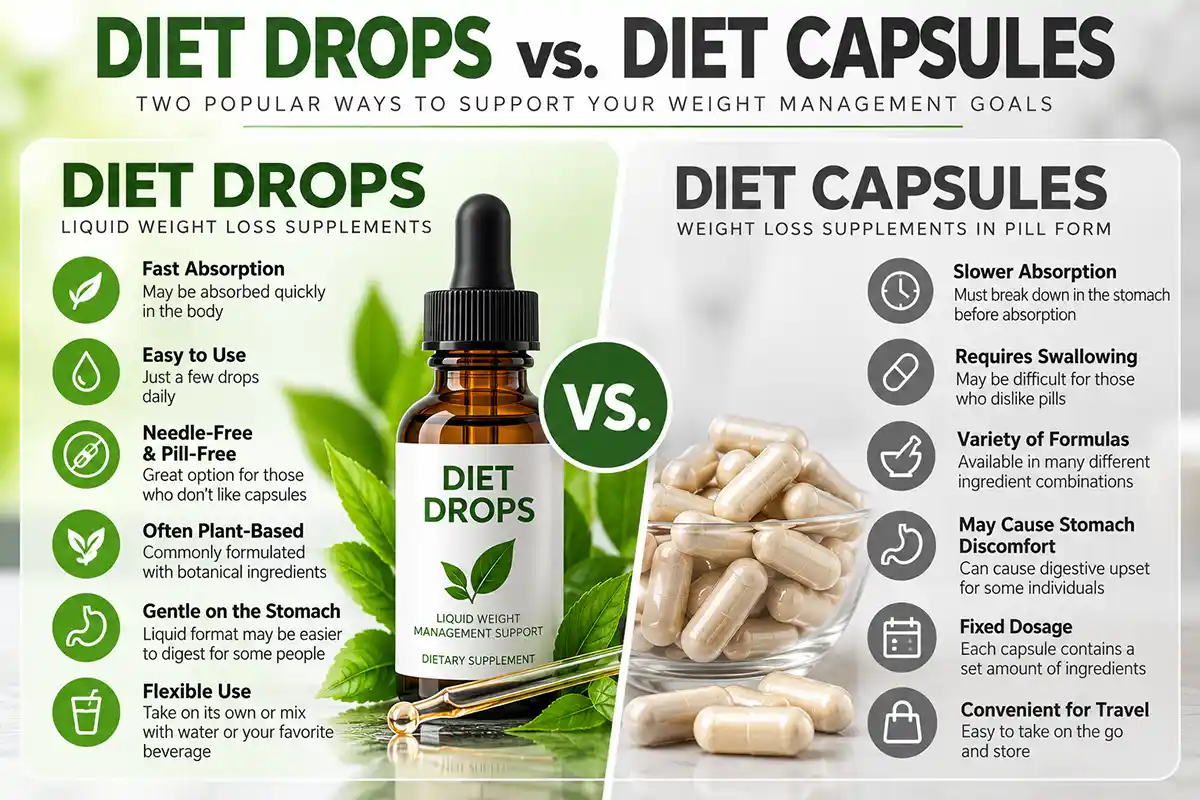
Diet Drops vs. Capsules: What’s the Difference, and Which Is Better for Weight Management?
Introduction: Understanding Two Popular Weight Management Supplement Formats
When researching weight management supplements, consumers often encounter two popular formats: liquid diet drops and dietary supplement capsules.
Both are marketed for a variety of purposes, including metabolism support, energy, appetite management, and general weight-management routines.
But what actually separates them?
Is a liquid supplement absorbed more quickly? Are capsules more concentrated? Does placing drops under the tongue make them more effective? Can either format produce meaningful weight loss?
These questions deserve more than a simple product comparison.
Although liquid and capsule supplements can differ in their physical characteristics and administration, neither delivery format automatically provides better weight-loss results.
The more important considerations are the active ingredients, ingredient amounts, product formulation, quality controls, individual health circumstances, and clinical evidence.
Let’s explore these differences in detail.
1. What Are Diet Drops?
Diet drops are liquid products marketed for weight management or related wellness goals.
They typically come in small bottles equipped with droppers, dispensing tips, or other measuring devices.
Depending on the product, the manufacturer may instruct consumers to swallow the liquid directly, dilute it in water, or hold it under the tongue.
Not all diet drops are formulated the same way.
Some contain botanical extracts, vitamins, amino acids, or other dietary ingredients. Others may contain combinations of several substances.
Liquid formulations can also contain water, glycerin, alcohol, flavorings, preservatives, or other ingredients used to maintain stability and usability.
Potential advantages of liquid supplements
Liquid products may be appealing to consumers who dislike swallowing capsules.
Some also allow different measured serving sizes when the manufacturer provides appropriate instructions.
However, flexible serving sizes should not be confused with permission to increase doses beyond label directions.
Potential disadvantages of liquid supplements
Liquid supplements may require careful measurement.
A dropper that is not calibrated, or instructions that rely on an imprecise number of drops, can make consistent administration more difficult.
Some liquids also have noticeable flavors, require refrigeration after opening, or have specific storage requirements.
Consumers should read the label rather than assume all liquid supplements share these characteristics.
2. What Are Diet Capsules?
Diet capsules are supplements enclosed in a capsule shell, commonly made from gelatin or plant-derived materials.
The capsule may contain a powder, granules, a liquid, or another prepared formulation.
Weight-management capsules are frequently marketed using terms such as metabolism support, thermogenic support, appetite management, or energy support.
These descriptions do not automatically establish that a product produces weight loss.
Potential advantages of capsules
Capsules typically provide a predetermined amount of their contents per unit.
This can simplify routine administration and reduce the need to measure each serving.
They are also generally convenient to carry and may conceal the taste of ingredients that would otherwise be unpleasant.
Potential disadvantages of capsules
Some consumers have difficulty swallowing capsules.
Capsules can also contain excipients, fillers, or shell ingredients that may be unsuitable for particular dietary preferences or sensitivities.
The quantity of an ingredient inside a capsule does not, by itself, establish its biological activity or effectiveness.
3. Are Diet Drops Absorbed Faster Than Capsules?
One of the most common claims in supplement marketing is that liquid drops are absorbed faster than capsules.
This statement requires qualification.
A liquid formulation does not need to undergo the same capsule-shell disintegration step as a conventional capsule. However, that does not mean its active ingredients necessarily enter the bloodstream more quickly or in greater amounts.
Absorption depends on several factors:
-
- The chemical properties of the ingredient
-
- Whether the ingredient is dissolved or suspended
-
- The formulation’s stability
-
- Gastrointestinal conditions
-
- The presence of food
-
- The administration route
-
- The individual’s physiology
A swallowed liquid may still travel through the digestive tract and undergo processes similar to those affecting ingredients released from capsules.
Likewise, some capsule formulations are specifically engineered to alter the release or absorption of their contents.
What about sublingual diet drops?
Sublingual administration means placing a substance under the tongue.
Certain substances can be absorbed through tissues in the mouth when appropriately formulated.
However, not every ingredient is suitable for meaningful sublingual absorption.
Simply placing a liquid supplement under the tongue does not prove that its ingredients bypass digestion, avoid first-pass metabolism, or become more bioavailable.
Product-specific pharmacokinetic research is needed to support those claims.
Bottom line: The assertion that all diet drops absorb faster than capsules is not scientifically justified.
4. Which Is Better for Appetite Management?
Some weight-management supplements are marketed to support satiety or appetite control.
The ingredients used for these purposes vary substantially.
For example, certain dietary fibers have been investigated for their effects on fullness and food intake.
However, an ingredient that requires a substantial amount of material may be difficult to deliver in a small-volume liquid serving.
Other ingredients can be incorporated into either liquid or capsule products.
What matters most is whether the ingredient and dose have been adequately evaluated.
A liquid product should not be assumed to suppress appetite more effectively because it is administered through a dropper.
Similarly, a capsule should not be assumed to have stronger appetite-related effects because it contains a concentrated extract.
5. Diet Drops vs. Capsules for Metabolism Support
Metabolism refers to the chemical processes through which the body uses and stores energy.
Supplement marketers often use the phrase “metabolism booster” to describe products containing caffeine, botanical extracts, or other ingredients.
Some ingredients have been studied for their effects on energy expenditure or related physiological measurements.
But a change in a metabolic marker does not necessarily translate into substantial, sustained weight loss.
For example, caffeine can temporarily influence energy expenditure, but its effects and tolerability vary.
Products containing stimulants may also cause nervousness, sleep disturbances, palpitations, or other adverse effects.
The relevant question is not whether the ingredient is in a liquid or capsule.
It is whether the amount, formulation, and evidence support a meaningful benefit at an acceptable level of risk.
6. Understanding Ingredient Concentration
A common misconception is that a smaller serving must contain a more powerful formula.
Liquid supplements may be highly concentrated, but concentration alone is not a measure of effectiveness.
Likewise, a large capsule may contain substantial amounts of inactive material or ingredients with limited evidence.
Consider two hypothetical products.
Product A: Liquid drops
-
- Serving size: 1 mL
-
- Declared botanical extract: 100 mg
-
- Servings per container: 30
Product B: Capsules
-
- Serving size: 2 capsules
-
- Declared botanical extract: 250 mg
-
- Servings per container: 30
Product B contains more of the declared extract per serving, but that does not prove it is more effective.
The extracts might differ in composition, standardization, purity, or biological activity.
A meaningful comparison requires understanding what the extract contains and whether the amount is supported by research.
7. Which Format Is Easier to Use Every Day?
Daily convenience can influence whether someone follows product instructions consistently.
For some people, taking a capsule with water is simple.
Others prefer drops because they dislike swallowing pills.
Liquid supplements may fit easily into a routine at home, while capsules may be more convenient during travel.
Neither preference is inherently better.
The most suitable format is one that can be used accurately, safely, and consistently when there is a legitimate reason to take the supplement.
8. Comparing the Cost of Diet Drops and Capsules
Bottle price alone can be misleading.
A $30 bottle of drops may contain fewer daily servings than a $40 bottle of capsules.
To compare costs, calculate:
Cost per serving = Product price ÷ Number of servings
For example:
Liquid supplement:
$36 ÷ 30 servings = $1.20 per serving.
Capsule supplement:
$42 ÷ 60 servings = $0.70 per serving.
The capsule product costs less per labeled serving in this hypothetical comparison.
However, cost per serving is not the same as cost per effective dose.
If the formulas differ, a simple price comparison may not capture their relative value.
9. Safety Considerations for Diet Drops and Capsules
Both liquid and capsule supplements can cause adverse effects.
Risk depends primarily on the ingredients, amounts, contamination or adulteration, medication interactions, and individual health factors.
Liquid supplements may contain alcohol or other solvents that consumers should be aware of.
Capsules may contain allergens or ingredients that conflict with dietary restrictions.
Some weight-management products contain stimulants that can affect sleep, blood pressure, or heart rate.
Certain botanical ingredients may interact with prescription medications.
People who are pregnant, breastfeeding, taking medications, or managing medical conditions should seek individualized medical guidance before using weight-loss supplements.
Consumers should also be cautious about products promising rapid or dramatic weight loss.
10. Are Diet Drops More Natural Than Capsules?
The word “natural” is commonly used in supplement marketing, but it is not a reliable indicator of safety or effectiveness.
Both drops and capsules can contain plant-derived ingredients.
Both can also contain synthetic ingredients, processing aids, preservatives, or other formulation components.
A natural ingredient can still produce adverse effects or interact with medication.
The better approach is to evaluate the complete ingredient list and supporting evidence.
11. How to Read Diet Drop Labels
Start by identifying the serving size.
Liquid supplements may express serving sizes in milliliters, teaspoons, or other units.
Check whether the dropper includes calibrated markings.
Next, identify each dietary ingredient and its amount per serving.
Pay attention to proprietary blends, especially when individual ingredient quantities are not disclosed.
Review other ingredients, including solvents, sweeteners, flavorings, and preservatives.
Finally, examine warnings, expiration information, manufacturer details, and any available independent quality testing.
12. How to Read Diet Capsule Labels
Capsule labels should also be evaluated using the Supplement Facts panel.
Check whether one serving means one capsule, two capsules, or more.
Read the ingredient amounts on a per-serving basis rather than assuming they refer to a single capsule.
Review the capsule shell and other ingredients for potential allergens or dietary concerns.
Investigate any claims about delayed release, enhanced absorption, or specialized delivery technology.
These claims should be supported by appropriate evidence.
13. What Does Science Say About Weight Loss Supplements?
The National Institutes of Health Office of Dietary Supplements reports that many ingredients promoted for weight loss have limited or inconsistent evidence of effectiveness.
Some have been associated with small effects in certain studies, while others have not demonstrated meaningful benefits.
Combination products present additional challenges because research on individual ingredients may not establish the effects of the finished formula.
Consumers should be skeptical of marketing that presents preliminary laboratory findings as proof of substantial human weight loss.
The same evidence standard should apply to both drops and capsules.
14. How to Choose Between Diet Drops and Capsules
The best decision starts with the reason for considering a supplement.
Ask whether the product addresses a clearly identified need and whether reliable research supports its use.
Next, compare the actual formulations.
If two products contain different ingredients, comparing their physical formats alone tells you very little about their potential benefits.
Review safety information and consult a healthcare professional when appropriate.
Then consider convenience, taste, measurement accuracy, storage requirements, and cost.
For people who have difficulty swallowing capsules, a liquid may be more practical.
For people who prefer premeasured servings and portability, capsules may be more convenient.
Neither format should be treated as a substitute for evidence-based weight-management care.
15. Frequently Asked Questions
Are diet drops better than capsules?
Not necessarily. The better choice depends on the ingredients, formulation, evidence, safety, and individual preferences.
Do diet drops work faster?
Some liquids may release ingredients more quickly than certain capsules, but faster release does not necessarily mean faster absorption or better weight-loss results.
Can diet drops be taken under the tongue?
Only according to the manufacturer’s directions. Sublingual use does not guarantee improved absorption.
Are capsules stronger than drops?
Not automatically. Strength and effectiveness depend on the actual ingredients and their amounts, not the physical format.
Which is easier to travel with?
Capsules are often convenient for travel because they are premeasured and less prone to spilling. Liquid products may be subject to additional packing restrictions.
Are diet drops safer than capsules?
Neither format is inherently safer. Safety depends on the product and the individual taking it.
Can I take diet drops and capsules together?
Combining supplements may duplicate ingredients or increase exposure to stimulants and other substances. A healthcare professional or pharmacist should review the specific products before they are combined.
Do diet drops help burn belly fat?
There is no reliable basis for assuming that liquid diet drops selectively reduce abdominal fat. Claims about targeted fat loss require strong clinical evidence.
Do diet capsules help burn belly fat?
The same limitation applies to capsules. A capsule format does not provide a mechanism for selectively reducing fat from a particular body area.
Are expensive diet drops more effective?
Price is not proof of effectiveness. Evaluate clinical evidence, ingredient transparency, quality testing, and cost per serving.
Final Verdict: Diet Drops or Capsules?
Diet drops and capsules offer different ways to deliver dietary ingredients, but the delivery format alone cannot determine which product is better for weight management.
Liquid drops may be preferable for people who dislike swallowing pills or need a suitable liquid formulation.
Capsules may appeal to people who value premeasured servings, portability, and minimal taste.
The most important questions remain the same regardless of format: What does the product contain? Is the amount appropriate? What does reliable research show? What are the risks? And is the finished product supported by evidence?
An informed consumer should evaluate those questions before relying on claims about faster absorption, stronger metabolism support, or superior weight-loss results.
The best supplement decision is based on transparency, evidence, and safety—not packaging alone.
Medical disclaimer: This article is for general educational purposes and does not replace individualized medical advice. Dietary supplements are not approved by the FDA for safety and effectiveness before marketing. Consult a qualified healthcare professional about weight-management treatments and potential supplement interactions.
Lorem ipsum dolor sit amet, consectetur adipiscing elit. Ut elit tellus, luctus nec ullamcorper mattis, pulvinar dapibus leo.
Lorem ipsum dolor sit amet, consectetur adipiscing elit. Ut elit tellus, luctus nec ullamcorper mattis, pulvinar dapibus leo.



Add comment